Top Desert Luxury Resorts in America: A Strategic Audit for Travelers
The luxury resort in an arid environment represents one of the most complex operational paradoxes in the hospitality sector. It is an exercise in resource defiance: creating a sanctuary of abundance within a landscape fundamentally defined by scarcity. To the untrained eye, these properties, top desert luxury resorts in America, are defined by their aesthetics—the infinity pools that seem to drop off into the canyon floor, the curated spa menus, or the minimalist architectural lines that mirror the surrounding geology. However, a rigorous analysis reveals that the success of these resorts is rooted not in their aesthetic, but in their capacity to manage the extreme physical and logistical stresses inherent to desert geography.
Operating a high-end property in the American Southwest or the Basin and Range province requires a sophisticated handling of the “desert physics” equation. A resort must contend with extreme diurnal temperature shifts, the constant threat of infrastructure failure during heat spikes, and the inherent fragility of local water tables. When we evaluate the viability of a destination, we are essentially auditing its internal engineering. Properties’ top desert luxury resorts in America that succeed in this environment treat the desert as a partner, integrating their water management, HVAC systems, and landscape architecture into the ecosystem. Properties that attempt to force a non-native service model onto the landscape—such as those attempting to replicate the lush, water-intensive aesthetic of a tropical resort—inevitably suffer from operational fragility and diminishing returns.
The objective of this analysis is to provide a definitive, system-level understanding of the industry. It moves beyond the marketing veneer to examine the structural, financial, and environmental frameworks that separate a resilient, top-tier asset from one that is merely a temporary installation. For the serious traveler or the professional organizer, the following breakdown offers the intellectual framework necessary to differentiate between genuine architectural and operational achievement and the superficial mimicry that frequently pervades the market.
Understanding “top desert luxury resorts in America.”
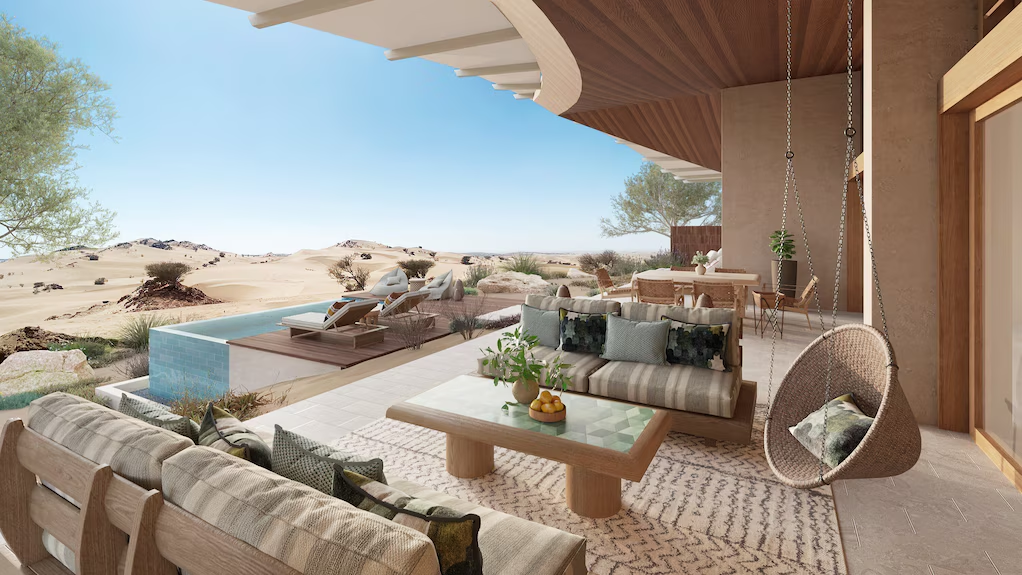
The designation of top desert luxury resorts in America is often treated with a lack of critical rigor. Aggregators and lifestyle publications frequently rank properties based on visual impact or celebrity appeal, metrics that have little bearing on the actual quality of the guest experience or the institutional stability of the property. The primary misunderstanding is the assumption that luxury is a constant—that a brand name, once applied, ensures the same level of service and infrastructure regardless of the resort’s isolation, local climate, or supply chain access. This is a profound miscalculation.
The reality of operating at the top of the market in a desert environment involves a constant battle against entropy. When we discuss top desert luxury resorts in America, we are really discussing properties that have solved the “hostility” of their location. They have developed the logistical competence to maintain a high-touch, frictionless environment while operating in a zone where the environment itself is antagonistic to high-maintenance equipment and perishable inventories.
The oversimplification risk here is the “Resort-as-a-Vacuum” fallacy. Many travelers view these destinations as hermetically sealed bubbles where the outside world does not exist. This is the surest way to fail in planning a visit. The best properties are not islands; they are hyper-aware nodes within a regional network. They interact with local resources, local talent pools, and local conservation efforts. A property that tries to fully insulate itself from the desert context usually ends up feeling artificial, brittle, and, ultimately, less luxurious than one that embraces the rugged reality of its geography.
Deep Contextual Background: The Evolution of Hospitality Logic
Historically, the desert resort emerged from the confluence of the “health retreat” movement of the early 20th century and the mid-century rise of the American road trip. The architecture was utilitarian, focused on maximizing airflow and natural cooling. This was the era of the “Sanatorium Aesthetic”—clean, stark, and focused on the restorative power of the dry heat.
As the industry professionalized in the late 20th century, the aesthetic shifted toward the “Oasis Model.” Architects and developers began to ignore the desert climate, instead importing non-native flora and water-heavy layouts to mimic the green, lush aesthetic of the East Coast or the Caribbean. This was an era of unsustainable growth and high resource consumption. We are now in the third phase of this evolution: the “Regenerative Desert” phase.
Modern, highly-regarded properties are returning to the wisdom of the early pioneers, but with 21st-century technology. They are adopting xeriscaping, solar integration, and bioclimatic building techniques. The industry has realized that the true luxury in the desert is not the presence of abundant water in an arid land, but the seamless integration into the arid land itself. The properties that currently lead the market are those that demonstrate technical, rather than just aesthetic, maturity.
Conceptual Frameworks and Mental Models
To assess the quality of any given property, one must employ a structured approach that prioritizes operational metrics over marketing brochures.
-
The Bioclimatic Integration Metric: Does the resort’s architecture work with the desert’s diurnal temperature shift, or does it fight it? A property that relies solely on massive HVAC loads to maintain internal comfort is a property with high operational risk. A top-tier property utilizes thermal mass, passive shading, and localized cooling to stabilize its interior.
-
The Logistical Friction Index: How difficult is it for the resort to maintain its standard of service? A remote property that sources its food, laundry, and labor from hundreds of miles away has a much higher potential for “service drift” than a property with localized, resilient supply chains.
-
The Resource-Density Ratio: This measures the amount of infrastructure required to sustain one guest. An elite property minimizes this footprint.
Key Categories and Operational Variations
We can group high-end arid properties into several distinct operational archetypes, each requiring a different approach from the traveler.
The realistic decision logic requires aligning your personal travel goal with the resort’s operational archetype. If your objective is “total detachment,” look to the Remote/Wilderness category, but be prepared for the risks associated with supply chain fragility. If your objective is “predictable luxury,” the Oasis/Valley resorts provide the highest level of logistical redundancy.
Detailed Real-World Scenarios
Scenario 1: The Energy Grid Dependency. A resort in the high desert experiences an extreme heat event that strains the local power grid. A property with robust, on-site solar and battery storage systems maintains a seamless guest experience. A resort relying entirely on the local utility suffers brownouts, leading to localized service disruptions (e.g., failed climate control, limited dining service). The difference is in the property’s infrastructure capital investment.
Scenario 2: The Water Scarcity Pivot. A regional drought triggers local water usage restrictions. A property that has integrated water reclamation and native planting barely notices the change in operational parameters. A property that relies on thirsty, non-native landscaping faces a crisis, forcing it to cut back on guest amenities (e.g., limiting pool hours or reducing restaurant services) to remain compliant.
Scenario 3: The Labor Retention Challenge A luxury resort in a remote desert region struggles to staff its front-of-house departments due to the difficulty of local housing. A property that has invested in dedicated, high-quality staff housing retains its team year-round, ensuring service consistency. A property that relies on daily commuting labor finds its service quality volatile, as staff availability fluctuates with traffic, weather, and seasonal tourism cycles.
Planning, Cost, and Resource Dynamics
The pursuit of the top desert luxury resorts in America involves a hidden calculus of costs that are rarely articulated in the base nightly rate.
The opportunity cost of failing to audit these dynamics is a high probability of “infrastructure-related disappointment.” A resort that is expensive but poorly engineered for its climate will inevitably provide a lower return on the guest’s time than a more modest property that is technically sound.
Tools, Strategies, and Support Systems
-
The Infrastructure Query: Contact the resort management 30 days before booking. Ask specific questions about their power and water autonomy. A property that is transparent about its systems is usually a property that is confident in its operations.
-
The Satellite Audit: Use mapping tools to examine the density of the resort’s surrounding area. Is it a sprawling complex of water-intensive turf? This is a red flag for long-term operational instability.
-
The “Third-Party Reliability” Check: If the resort offers excursions (guided hikes, photography tours), ask about the ownership of the equipment and the staff. Resorts that own their operations have higher consistency; those that outsource to local vendors carry a higher risk of service drift.
-
The Service Continuity Assessment: Inquire if the resort has a year-round management team. Resorts that cycle management with the seasons are often reactive rather than proactive.
Risk Landscape and Failure Modes
There is a distinct taxonomy of failure in the desert luxury market, often compounding if ignored.
-
The Maintenance Debt: Desert heat and UV exposure destroy exterior finishes and mechanical equipment at 2-3x the rate of temperate climates. If a property isn’t reinvesting heavily in its physical plant annually, the degradation will be visible and painful.
-
The “Experience Bloat”: Properties that attempt to offer an “all-inclusive” experience often dilute their focus. They end up with high-quality rooms but mediocre dining and poorly trained activity guides.
-
The Climate Fragility: When the environment is pushed too hard (e.g., through excessive water usage), the resort loses its unique selling proposition. It ceases to be an authentic desert experience and becomes a generic luxury product that happens to be located in the desert.
Governance, Maintenance, and Long-Term Adaptation
The top-tier properties are those that view their desert location as a constraint to be leveraged, not a condition to be masked. They engage in long-term governance of their site, prioritizing xeriscaping, gray-water recycling, and the protection of local flora. When evaluating a resort, look for signs of “adaptive governance.” Do they host local conservation groups? Do they have a clear plan for managing their resource usage during drought years? The best properties are not static; they are in a constant state of adjustment to their environment.
Measurement, Tracking, and Evaluation
-
Leading Indicators: The precision and clarity of pre-arrival information. A resort that provides detailed, accurate data about what to expect—weather, hydration requirements, logistical coordination—is a resort that respects the complexity of the environment.
-
Lagging Indicators: The consistency of service delivery across all hours of the day. If the level of service in the morning shift varies wildly from the evening shift, the management lacks a unified, resilient system.
-
Qualitative Signals: Observe the staff’s attitude toward the environment. If the staff speaks about the desert with respect, knowledge, and care, it is a leading indicator that the property culture is aligned with its geography.
Common Misconceptions and Oversimplifications
-
“Newer Resorts are Always Better.” New resorts often suffer from “teething” problems in their infrastructure. Older, well-maintained properties have usually worked out the logistical kinks of their specific site.
-
“High Price is a Proxy for Sustainability.” Many expensive resorts are highly wasteful. Sustainability is a specific operational choice, not a price point.
-
“The Concierge is an Authority.” The concierge is a service professional with a set of vendor partnerships. They are an asset, but they are not the source of truth regarding the property’s operational stability.
-
“Desert Resorts are all the Same.” The operational reality of a Sedona property is vastly different from a Palm Springs property. The difference in elevation, humidity, and water source makes them fundamentally different businesses.
Ethical, Practical, and Contextual Considerations
The American desert is a resource-constrained, fragile environment. The ethics of luxury in this context are inextricably tied to the management of water and energy. A resort that treats water as an infinite resource is not just being wasteful; it is being predatory on the local ecosystem. The most sophisticated travelers are now auditing the “Resource-Density Ratio” of their destinations. They are choosing to stay at properties that work to replenish, rather than deplete, the arid lands they occupy. This is the new benchmark for excellence in the sector.
Synthesis and Conclusion
The search for the top desert luxury resorts in America is not a hunt for the most opulent decor, but a search for the most capable systems. The most successful properties in this category have achieved a state of operational equilibrium. They have recognized the constraints of the American desert—the heat, the scarcity, and the fragility—and have built an experience that functions within those boundaries, rather than attempting to ignore them.
For the serious traveler, the goal is to shift from a role of passive consumption to one of active evaluation. By scrutinizing the infrastructure, auditing the resource management, and prioritizing properties that demonstrate long-term ecological and community stewardship, one can secure an experience that is structurally sound and environmentally authentic. The true luxury of the American desert is found in the reliability of the property, the intelligence of its design, and the seamlessness of its integration into the landscape. This is the gold standard for the modern desert retreat: an experience defined not by excess, but by the absence of operational friction in one of the most challenging environments on Earth.